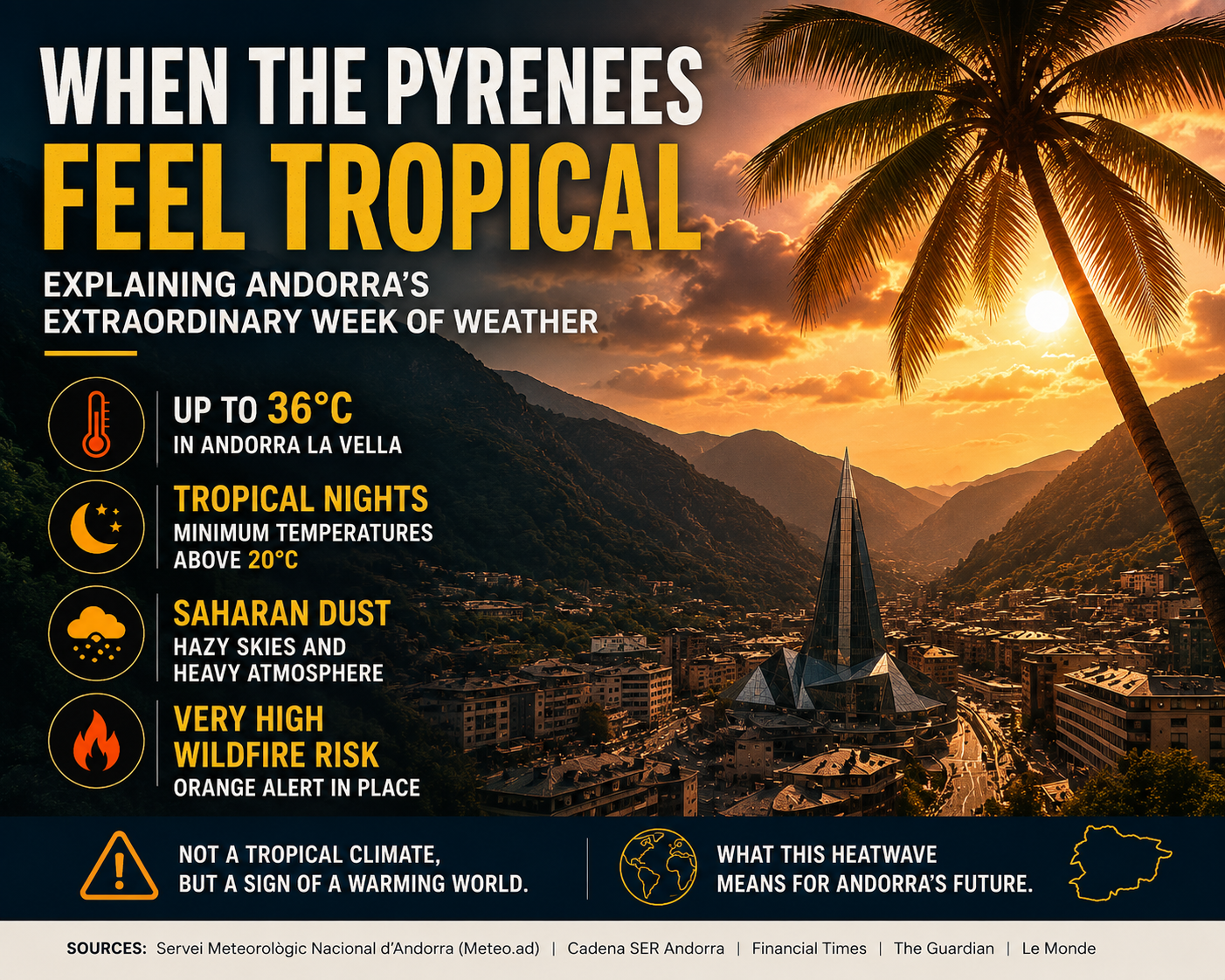
This week, Andorra has experienced one of its most remarkable summer weather episodes in recent years. Temperatures have climbed to 36°C in Andorra la Vella, while nighttime temperatures have remained above 20°C in several locations, producing what meteorologists classify as tropical nights—a phenomenon once considered exceptional in the Pyrenees but becoming increasingly frequent.
For residents, the sensation has been striking. Instead of the cool mountain evenings that traditionally provide relief after a hot day, the air has remained warm overnight, making sleep more difficult and preventing buildings from cooling naturally. Combined with Saharan dust, hazy skies and persistent sunshine, the weather has felt more characteristic of coastal Mediterranean regions than of a country whose average elevation exceeds 1,900 metres.
A Heatwave Driven by Atmospheric Blocking
The current episode is the result of a strong subtropical high-pressure system extending across southwestern Europe. This “heat dome” suppresses cloud formation, weakens atmospheric circulation and allows hot air originating from North Africa and the Iberian Peninsula to accumulate over the region.
The consequence is prolonged sunshine, very light winds and a continuous build-up of heat during successive days. At the same time, the freezing level has risen to around 4,400–4,500 metres, exceptionally high for the central Pyrenees, illustrating just how warm the entire atmosphere has become.
Why Tropical Nights Matter
While daytime temperatures attract headlines, many climatologists argue that warm nights are the more significant indicator of climate change.
Normally, mountain environments cool efficiently after sunset because of their elevation and dry air. This week, however, minimum temperatures have remained above 20°C in parts of Andorra, marking consecutive tropical nights.
These warm nights reduce the body’s ability to recover from daytime heat, increase heat stress and raise health risks, particularly for older adults and vulnerable populations. Across Europe, tropical nights have become more common over recent decades as average temperatures continue to rise.
More Than Just High Temperatures
The heat has produced a cascade of secondary effects across the country.
Authorities have maintained an orange heat alert, while forest fire danger has increased to very high in central parishes. Dry vegetation, prolonged sunshine and low soil moisture create ideal conditions for wildfire ignition, meaning even small human activities can have serious consequences.
The atmosphere has also contained suspended Saharan dust, reducing visibility and making the heat feel heavier than temperature readings alone would suggest.
Is This the New Normal?
One exceptional week does not redefine Andorra’s climate. The country remains a mountain climate with strong seasonal contrasts.
However, climate observations across Europe indicate that extreme heat events are becoming more frequent, more intense and longer-lasting. Scientists have also observed that Europe is warming faster than the global average, increasing the likelihood that mountain regions such as Andorra will experience heatwaves that would once have been considered extraordinary.
For Andorra, this means summers increasingly characterised by:
- More frequent heatwaves;
- A growing number of tropical nights;
- Increased wildfire risk;
- Greater stress on water resources and ecosystems;
- More challenging conditions for residents, visitors and outdoor workers.
Looking Ahead
Forecasts suggest that temperatures will ease slightly after the peak of the current heatwave, although conditions will remain warmer than is typical for mid-July. There is also a possibility of isolated afternoon thunderstorms later in the week, a common response when intense mountain heating finally destabilises the atmosphere.
As remarkable as this week’s weather has been, it also offers a glimpse into the future challenges facing mountain regions. The Pyrenees are not becoming tropical—but they are becoming warmer, and episodes like this are expected to become less exceptional in the decades ahead.
FAQ: Andorra’s Tropical-Like Heatwave
Is Andorra becoming a tropical country?
No. Andorra remains a mountain climate in the Pyrenees. This week’s conditions are best described as tropical-like weather during an exceptional heatwave, not a permanent shift to a tropical climate.
What is a “tropical night”?
A tropical night occurs when the minimum temperature does not fall below 20°C. During this event, stations such as La Comella and Engolasters recorded minima around 20.1°C. Source: Cadena SER Andorra; Financial Times.
Why has the heat felt so intense?
Several factors combined:
- Daytime temperatures near 36°C in Andorra la Vella.
- Very warm nights that prevented cooling.
- Saharan dust (calitja) in the atmosphere.
- High humidity, which increased the feeling of discomfort.
What caused this heatwave?
A strong subtropical high-pressure system (“heat dome”) over southwestern Europe trapped hot air and suppressed cloud formation, allowing temperatures to build over several days.
Why are warm nights important?
Warm nights are often more dangerous than hot afternoons because the body has less opportunity to recover from heat stress during sleep. Scientists increasingly view the rise in tropical nights as a significant indicator of climate warming. Source: Financial Times.
Has Andorra issued heat warnings?
Yes. Authorities maintained an orange alert for high temperatures during the peak of the heatwave and warned of increased wildfire risk, particularly in central parishes. Source: Cadena SER Andorra.
Is wildfire risk higher during this event?
Yes. Prolonged heat, dry vegetation, and limited recent rainfall significantly increased forest-fire danger, leading civil-protection authorities to classify parts of the country as very high risk. Source: Cadena SER Andorra.
Will weather like this become more common?
Climate research suggests that heatwaves, tropical nights, and prolonged warm periods are becoming more frequent across Europe. While individual events cannot be attributed solely to climate change, the long-term trend points toward a warmer climate and more frequent extreme heat episodes. Sources: Financial Times; Le Monde; Meteo.ad.
What should residents do during tropical nights?
Health authorities generally recommend:
- Hydrating regularly.
- Keeping living spaces shaded during the day.
- Ventilating during the coolest hours available.
- Reducing strenuous activity during peak heat.
- Checking on elderly or vulnerable people.
Sources
Primary Andorran source
- Cadena SER Andorra — Andorra maintains orange heat alert and raises forest-fire risk (published 15 July 2026). Reported temperatures near 36°C in Andorra la Vella, tropical-night minima above 20°C at La Comella and Engolasters, Saharan dust, and increased wildfire danger.
Additional reporting and climate context
- Alto.ad — Andorra records tropical nights as heatwave intensifies (15 July 2026). Details on minimum temperatures, orange heat alerts, and the persistence of the heatwave.
- Financial Times — Tropical nights come to Europe (11 July 2026). Explains the increasing frequency of tropical nights across Europe and their health implications.
- The Guardian — Europe braces for another heat surge as tropical nights return (6 July 2026). Provides regional context for the broader European heat episode.
- Le Monde — France’s third heatwave of the year drags on (10 July 2026). Discusses recurring heatwaves in southwestern Europe and unusually warm nights.
Official meteorological reference
- Servei Meteorològic Nacional d’Andorra (Meteo.ad) — operational forecasts, warnings, and climate information for Andorra.


