Alt de la Capa: The Pyrenees Viewpoint That Surprises Every Visitor
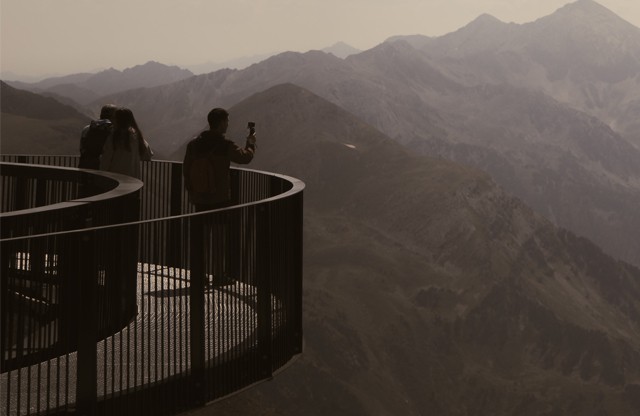
A scenic viewpoint at the summit of Alt de la Capa, is being built and designed by architect Toni Riberaygua at 2,572 metres above sea level in the upper part of the Pal Arinsal ski area.
Andorra la Vella | 4 October 2026
In brief: The parish of La Massana is building a scenic viewpoint at the summit of Alt de la Capa, at 2,572 metres above sea level in the upper part of the Pal Arinsal ski area. The municipal investment is around €837,000. The structure will offer 360-degree views by day and work as a stargazing amphitheatre by night. It is designed as a demountable structure on a single anchor point. A thematic walking path of about 800 metres will lead up to it. Work is expected to start before this winter, and the viewpoint could be fully operational in summer 2027 if the weather allows.
A viewpoint designed as a mountain stage
Andorra already has a growing family of landmark lookouts, from Roc del Quer in Canillo to the Tristaina solar viewpoint in Ordino. The Alt de la Capa project takes a different approach. La Massana does not want a platform where visitors take a photo and leave. It wants a place where things happen.
That ambition shaped the design. The viewpoint, designed by architect Toni Riberaygua and engineer Carles Puig, has a concave shape with tiered seating, a kind of mountain amphitheatre. According to the designers, this form shelters visitors from the weather during shows and astronomical observations.
Tourism councillor Mònica Solé described the concept as a singular mountain space for cultural activities and experiences linked to the territory, beyond simply looking at the landscape or the sky.
The project was designed by architect Toni Riberaygua and engineer Carles Puig. Riberaygua previously designed the Tristaina Solar Viewpoint in Ordino-Arcalís, another high-altitude lookout in the Andorran Pyrenees and it was a success.
Technical profile: what is being built
The project’s main features, as presented by the Comú de la Massana:
One anchor point, minimal footprint
The most distinctive technical decision is to concentrate the entire infrastructure on a single anchoring point and build the viewpoint as a demountable structure. According to the project team, if the parish ever decided to change the model or remove the facility, the whole structure could be dismantled and recycled. Only the concrete anchor would remain on the ground, comparable to the base of a chairlift pylon.
The municipality says the goal from the start was to keep the impact on the mountain to a minimum.
A site that is already developed
La Massana’s mayor (Cònsol Major), Eva Sansa, explained that the site was chosen for its spectacular setting and for a very specific feature: the summit is already a developed area. A ski lift and other mountain-activity infrastructure are already there. The viewpoint will be visible from several points across the parish, especially Arinsal, and will rank among the highest scenic viewpoints in the Pyrenees.
The experience begins on the way up
The project is not limited to the platform at the top. The Comú is developing a thematic path that will interpret the territory, its heritage and the natural environment during the ascent. It is about 800 metres long with an 85-metre height gain, and it is intended to be accessible to all kinds of visitors.
In Solé’s words, the idea is to offer a complete experience that starts from the bottom, not just a point of arrival.
Day and night: connecting the viewpoint to Starlight La Massana
The viewpoint is closely tied to the parish’s astrotourism strategy. La Massana received the double Starlight certification on 10 January 2023: Starlight Tourist Destination for the whole parish and Starlight Reserve for the Comapedrosa Natural Park. The parish is known for some of the darkest skies in southern Europe, thanks to low light pollution and a small, dispersed population.
Two celestial viewpoints already exist in the parish: Roc de la Sabina, near Arinsal at 1,896 metres, and Coll de la Botella in Pal, at 2,115 metres. Alt de la Capa would sit well above both, and the tiered seating is oriented to make night-sky observation easier. The Comú plans to organise astronomical observations there.
The timing matters. According to the Starlight Foundation, the Andorra Comapedrosa Starlight Reserve and Tourist Destination will host the International Starlight Meeting in 2027, the same summer the viewpoint could open.
Why the project matters for Andorra’s tourism model
Pal Arinsal is a year-round mountain destination. The resorts of Pal and Arinsal were first linked by cable car in 2001, and the Vallnord area was created in 2004. Today the area is known for its bike park, international sporting events and, increasingly, dark-sky tourism.
A landmark structure at 2,572 metres adds three things to that offer:
- A visual symbol. The Comú hopes the structure will become an identifying element for Arinsal, visible from many points of the valley.
- A cultural venue. The amphitheatre allows concerts, talks and guided experiences at altitude.
- A bridge between seasons. Observation nights and summer activities can extend the economic calendar beyond ski season.
A new reason to visit Arinsal
Alt de la Capa is already a natural viewpoint. The official Andorra tourism route from Arinsal to Alt de la Capa describes the summit as offering magnificent panoramic views, while the hike itself is classified as very difficult, with approximately 771 metres of elevation gain.
The new project seeks to transform that existing landscape experience into a more accessible and programmable tourism product.
The proposed structure will have a 360-degree panoramic viewpoint and a concave, amphitheatre-like design that can also function as an outdoor stage. The Comú says the location was selected partly because infrastructure already exists in the area, meaning the project is not being introduced into an entirely untouched mountain setting.
For Arinsal, that distinction is important. The viewpoint is intended to create another reason for visitors to travel beyond the village and ski area, potentially encouraging them to spend more time in the parish rather than treating Arinsal simply as a winter base.
From a ski resort to a four-season destination
The most significant strategic argument for the Alt de la Capa project is seasonality.
Andorra’s tourism economy remains heavily connected to mountain and winter tourism. At the same time, the Government of Andorra identifies tourism as one of the country’s economic pillars, representing around 40% of GDP, and has explicitly highlighted the need for diversification and reduced seasonality. Govern d’Andorra
This is where the Alt de la Capa viewpoint fits into a broader national challenge. A mountain attraction that can operate conceptually across different seasons can help expand the reasons people visit Andorra outside the traditional ski calendar.

In summer, the attraction can focus on hiking, landscapes, mountain experiences and cultural programming. In autumn, it can become a destination for scenery and photography. In winter, its relationship with Pal Arinsal and the surrounding snow-covered landscape adds another dimension. At night, its altitude and location provide an opportunity for astronomy.
The objective is therefore not simply to build a place where visitors can take photographs. It is to create an experience that can be used in different seasons and for different purposes.
Connecting Andorra’s mountains with its night sky
One of the most distinctive elements of the project is its astronomical potential.
La Massana has international Starlight Reserve and Destination recognition because of the quality of its night skies and low levels of light pollution. The official tourism programme already promotes astronomical experiences throughout the year, including stargazing activities in the Comapedrosa area and at existing viewpoints in Arinsal and Pal. Visit Andorra
The Alt de la Capa viewpoint could extend that strategy to one of the highest points in the parish.
Its design has specifically considered night-time observation. According to the Comú, the structure is designed so that visitors inside the amphitheatre can lose the horizon from view and concentrate their gaze on the sky. Comú de la Massana
That creates a potentially distinctive proposition for Andorra: a high-altitude mountain venue where landscape tourism and astronomical tourism meet.
For a small country competing for attention with much larger European destinations, creating experiences that are geographically specific can be particularly valuable.
A potential cultural venue at 2,572 metres
The project also introduces another idea: turning the mountain itself into a cultural venue. The Comú describes the structure as both a viewpoint and a stage. Its altitude could make it one of Europe’s higher outdoor event spaces, allowing for small-scale concerts, cultural activities, astronomy events and other programming. This matters because tourism increasingly depends not only on destinations but on experiences.
A panoramic viewpoint can be visited once. A viewpoint that also hosts seasonal cultural events, guided astronomy sessions or special mountain experiences has the potential to generate multiple reasons for returning. The proposed interpretive access route could reinforce this approach by explaining the landscape, territory and heritage along the way.
In other words, the project attempts to combine several elements that already exist in Andorra’s tourism offer:
mountains + views + hiking + culture + astronomy + events
Why Arinsal is central to the project
The location also has a strategic relationship with Arinsal. The Alt de la Capa sits within the Pal Arinsal ski domain, and the project is intended to generate additional tourism activity connected to the resort and the village. The Comú has specifically linked the project to the objective of diversifying the tourism offer and generating new opportunities for Arinsal.
That could have implications beyond the viewpoint itself.
Visitors attracted to the mountain may also use accommodation, restaurants, shops, transport and other services in Arinsal and La Massana. The economic benefit, if the attraction generates sufficient visitor activity, would therefore not necessarily be limited to ticket or access revenue.
This is particularly relevant for a destination such as Andorra, where tourism is an interconnected ecosystem rather than a collection of isolated attractions.
A test of Andorra’s four-season tourism strategy
The municipality’s argument for the project is closely connected to one of the country’s most important tourism challenges: reducing dependence on a highly seasonal model.
Arinsal is internationally associated with skiing and the Pal Arinsal resort. But the mountain landscape around the village also provides opportunities for hiking, nature tourism, culture and astronomy.
The Alt de la Capa project is designed to bring several of these activities together. During the day, the attraction would offer panoramic views across the surrounding Pyrenees. Its amphitheatre could host small cultural events. At night, its design could facilitate observation of the sky.
This matters because a viewpoint is not necessarily just a viewpoint.
If it becomes a place for concerts, astronomy sessions, educational activities and other events, it can potentially generate reasons to visit at different times of the year. That is particularly relevant for La Massana, where tourism authorities have been working to strengthen the parish as a year-round destination.
The astronomy opportunity
The night sky is one of the project’s more distinctive elements. La Massana already has international Starlight recognition, reflecting the quality of its skies and the potential for astronomical tourism.
Alt de la Capa could add another high-altitude location to that offer.
The concept is particularly interesting because it connects two assets that Andorra already possesses but does not necessarily market together: the mountains by day and the stars by night.
A reversible structure
A visitor could theoretically experience the landscape from the same location in two completely different ways. That gives the project a potentially stronger identity than a conventional observation platform.
A reversible structure The structure focuses on a single point of connection with the ground, which minimizes environmental impact while lending the structure a reversible character and allowing for easy dismantling or relocation if necessary. Efforts have also been made to minimize disruption during the construction process itself. Approximately 80% of the structure will be prefabricated in a workshop, with only the essential work carried out directly at the summit.
Construction Stages
The project will be built in three phases: first, the foundations will be constructed on site; second, around 80% of the structure will be manufactured in a workshop during winter; and finally, it will be assembled on the mountain, piece by piece.
The structure’s components will weigh around 800 kg each and will be transported by helicopter to the summit, where they will be assembled like a giant puzzle. The design consists of circular rings that expand outward to form the viewing terraces. Its concave shape will help protect visitors from the wind, while access will be through the rear of the structure.
The main material will be weathering (Corten) steel, chosen for its warm, earthy colour, which helps it blend into the surrounding rock. It also develops a protective patina and requires little maintenance.
The viewpoint is intended to become a recognisable landmark integrated into the mountain landscape. Because of its position at the summit, it will be visible from various parts of the country, particularly from Arinsal, and could eventually become a new symbol of the village.
The Architect, Antoni Riberaygua Magallón
Antoni Riberaygua Magallón (known as Toni Riberaygua) is an Andorran architect based in Andorra la Vella. The Andorran College of Architects (COAA) lists him as a practising architect, member number 129.
His best-documented work is directly relevant to Alt de la Capa. He designed the Tristaina Solar Viewpoint (Mirador Solar de Tristaina) on the Peyreguils peak in Ordino-Arcalís, an altitude lookout that is also a sundial. The project was promoted by Joan Viladomat, with civil engineer Sergi Riba and structural engineer Lluís Moya. It has a 25-metre-diameter ring with 360-degree views and a 27-metre central mast that marks solar time. That gives him experience in one of Andorra’s most demanding building environments: high altitude, wind and snow. In fact the Tristaina Solar Viewpoint has been a success, since millions of people have already visited it.
Throughout his career, Riberaygua has participated in a broad range of architectural and urban projects in Andorra, working across residential, commercial, public and tourism-related developments. His professional experience includes projects involving public spaces, urban improvements, building rehabilitation, mountain infrastructure and architectural competitions.
Among his documented work are the Mirador de Maià in Pas de la Casa and projects involving the redevelopment of public spaces and urban areas. His professional collaborations have also included work with other Andorran architecture and engineering practices on projects ranging from residential developments to infrastructure and tourism facilities.
Riberaygua’s professional profile therefore combines architectural practice with a strong focus on public spaces, tourism, landscape and the particular technical and environmental challenges of building in Andorra’s mountainous territory. His portfolio demonstrates an interest in creating distinctive architectural interventions while maintaining a relationship with the surrounding landscape and the functional needs of the communities and visitors who use them.
The Engineer, Carles Puig Becerra
Carles Puig Becerra is a civil engineer based in Andorra, with professional experience spanning civil engineering, structural design, infrastructure, urban development and technical consultancy.
He studied engineering at the Universitat Politècnica de València and has developed his career within the Andorran engineering sector. His professional work has included projects involving structures, public works, roads, retaining systems, slopes, bridges, tunnels, water infrastructure and geotechnical and hydraulic studies. He has also worked with Building Information Modelling (BIM) methodologies, integrating digital design and coordination tools into engineering projects.
Puig Becerra has been associated with Valdés Enginyers S.L. and, more recently, became a co-founder of P&M Enginyeria, an Andorran engineering practice focused on civil engineering, buildings, urban planning and installations.
Among his recent work is his involvement in the design of the Alt de la Capa scenic viewpoint in Arinsal, La Massana. The project combines engineering and architectural considerations to create a panoramic viewpoint and cultural space in a challenging mountain environment. Its distinctive structural concept and the logistical requirements of constructing in an elevated location demonstrate the technical complexity of the project.
Alongside his professional practice, Puig Becerra has an academic background in concrete and structural materials, including research into the mechanical behaviour of concrete incorporating metallic fibres.
His career reflects a combination of technical engineering expertise, project development and practical experience in the distinctive infrastructure and construction environment of Andorra.
The debate: environmental concerns generate controversy
The project has drawn opposition. A Change.org petition, reported to have passed 3,775 signatures, asks for the works to be paused until full environmental and economic impact assessments are completed. The environmental association Apapma has warned about the “Disneyfication” of the mountains and called for less invasive alternatives such as improved trails. The Comú has decided to proceed, pointing to the already developed character of the site and the demountable design.
Also it is necessary to mention, that when a project takes place in Andorra it is common that groups of people organize themselves to stop it. On the other hand when Andorran politicans decide to reduce the heights of existing legal buildings (yes, it happens) or to expropriate land, no one signs or says nothing against it. So controversies only take place when prosperity takes place, but nor the opposite. Let’s hope one day, this situation reverses. With that said, it is worth mentioning that sometimes controversies help projects to succeed and today’s case is the perfect example of that.
The controversy may have given Alt de la Capa a visibility money cannot buy
There is an interesting paradox surrounding the project. The controversy that has challenged the development has also helped make Alt de la Capa a recognisable name in the national conversation.
Before the debate, the summit was primarily known to hikers, skiers and people familiar with the mountains around Arinsal. The discussion surrounding the proposed viewpoint has brought the name into wider public attention. That means the project has acquired something that tourism destinations normally spend considerable amounts of money trying to obtain: attention.
Whether that attention ultimately benefits the attraction is another question. Some people may discover Alt de la Capa because they want to visit the viewpoint. Others may discover it because they oppose the construction.
Either way, the debate has made the mountain part of a broader conversation about the future of Andorra.
The unexpected marketing success of Alt de la Capa
There is an amusing irony in the story. The people who have criticised the project have helped make it famous. A development that might otherwise have appeared in tourism brochures as another attractive mountain experience has instead become something people are already discussing before construction is complete.
That is an unusually powerful form of publicity. The next chapter, however, will be written differently. It will not be written by politicians nor by critics. It will not be written by tourism marketers. It will be written by the visitors.
They will decide whether Alt de la Capa becomes a quick photograph, a memorable excursion, a cultural venue, an astronomy destination — or one of the places visitors simply feel they have to experience when they come to Andorra. The critics may have made the project famous. The mountain will have to make it successful.
There is an interesting story here:
The project was approved on 28 September. The petition had already passed 2,300 signatures by that date, according to El Periòdic. By 1 October, the figure reported by Altaveu had exceeded 3,700.
That’s roughly 1,400 additional signatures in three days, based on those published snapshots.
But we can legitimately say:
Before a single visitor has stood on the completed platform, the project has already generated thousands of online signatures, a sustained national news cycle and coverage beyond Andorra.
That’s an objectively measurable statement. And that leads perfectly into our thesis:
The controversy has already done something invaluable for a tourism project: it has made people curious. The next test is whether curiosity becomes visitation.
The controversy has created a measurable pre-opening audience
We now have a fascinating sequence:
27 September: citizen campaign launched.
Within 48 hours: nearly 2,000 signatures.
28 September: more than 2,300 signatures reported as the Comú approved the project. d’Andorra
Early October: reporting put the petition above 3,700 signatures.
28 September: project approved for €892,148.54.
3 October: the story reaches La Vanguardia in Spain.
Summer 2027: planned opening.
That’s a genuine pre-launch attention curve.
The controversy has created curiosity. Visitors will create the verdict.
This may ultimately be the most interesting aspect of the entire project. The debate about Alt de la Capa has already produced opinions.
But opinions are not the final measure of a tourism attraction. Visitors are.
Right now, we cannot predict if the project is going to succeed or not. But we have great news. The controversy has helped the project to become famous. In fact, even international media like LaVanguardia has talked about Alt de la Capa viewpoint.
“Alt de la Capa controversy index”
Controversy is explained through numbers and here you will find them:
The business plan
It is not the first time Andorra has a viewpoint. The best viewpoints in the parish of La Massana include stunning high-mountain natural balconies and spots of scenic interest:
• Roc de la Sabina Viewpoint (Arinsal): Situated at an elevation of 1,896 meters on the CS-520 road, it offers panoramic views of the Comapedrosa Valleys Natural Park. It features picnic tables, barbecue areas, and accessible information panels with QR codes and Braille. actividadesenandorra.com +11
• Coll de la Botella Viewpoint (Pal): Located at an altitude of over 2,000 meters, it is notable for its expansive views of the valley and nearby peaks. It is home to the famous 13-meter-diameter aluminum sculpture *Tempesta en una tassa de te* (1991) by Dennis Oppenheim and is a popular spot for watching sunsets and stargazing. Andorra.com +12
• Font del Besurt Viewpoint: Located on the CG-4 road (between kilometer markers 8 and 9) at an elevation of approximately 1,786 meters, it is surrounded by lush coniferous forests and alpine meadows, right next to a rest area. actividadesenandorra.com
• Sant Cristòfol d’Anyós Viewpoint: Perched on a rocky outcrop above the village of Anyós, next to its Romanesque church, it offers a bird’s-eye view of the La Massana valley.
All and each one of them have been a success. Hundreds of thousands of tourists visit these viewpoints every year. Let’s keep in mind that Andorra receives millions of tourists per year and this trend is increasing over time. So, we can say:
The Comú has already commissioned a business plan that models visitor numbers and revenue. The municipality has not yet publicly disclosed those projections in the material surrounding the approval, but says the calculations include expected visitor numbers and an average price for those arriving via the resort’s lifts.
We don’t have enough information yet about the numbers that this new viewpoint will generate. But what we know is that previous viewpoints have been successful and this viewpoint offers something which others don’t. The Alt de la Capa viewpoint is not only an infrastructure where the tourist goes, makes a photo and live. It is something different, since it includes an amphitheatre and an emblematic space which will probably make tourists stay in the place. Time will tell.
What is still unknown
At the time of writing, the following have not been announced in the sources reviewed:
- Opening dates and visiting hours
- Entry conditions or pricing, if any
- How visitors will reach the start of the path (lift access or other)
- The programme of cultural and astronomical activities
Frequently asked questions
What is the Alt de la Capa viewpoint?
It is a scenic viewpoint under construction at 2,572 metres above sea level, at the top of Pal Arinsal in La Massana, Andorra. It offers 360-degree views and doubles as an amphitheatre for cultural events and stargazing.
How much does it cost?
The municipal investment is around €837,000.
When will it open?
Works are expected to begin before winter 2026. If weather permits, the viewpoint could be fully operational in summer 2027.
Who designed it?
Architect Antoni Riberaygua and engineer Carles Puig.
Will it damage the mountain?
No. The Comú says the structure uses a single anchor point and can be fully dismantled and recycled, leaving only a concrete base similar to a chairlift pylon. Critics argue that independent impact assessments should come first.
Is the path accessible for everyone?
The thematic path is about 800 metres long with 85 metres of elevation gain, and it is designed to be suitable for all audiences.
What is the Starlight connection?
La Massana holds double Starlight certification, and the viewpoint will support astronomical observation as part of that programme.
Sources & References
- Col·legi Oficial d’Arquitectes d’Andorra (COAA) — Official register of practising architects. Antoni Riberaygua Magallón appears as architect no. 129. COAA — Llistat d’arquitectes en exercici
- El Periòdic d’Andorra — Article about the project while mentioning its cost — El mirador de l’Alt de la Capa començarà a prendre forma abans de l’hivern amb una inversió de fins a 837.000 euros
- Diari d’Andorra — Report explaining the project Alt de la Capa and its openning in Summer 2027 — El mirador de l’Alt de la Capa obrirà durant l’estiu vinent
- Digital Andorra — Extensive and detailed article about the contruction of Alt de la Capa — Un mirador a 2.572 metres que vol convertir-se en la nova icona d’Andorra
- Nevasport — Public presentation of the new project — Presentación mirador Alt de la Capa de Arinsal
- Alto.ad — Report on Change.org petition to cancel the execution of the project — Petition Demands Halt to Alt de la Capa Viewpoint Over Environmental Fears
- Starlight Foundation —
- Visit La Massana — Images about Alt de la Capa
- LaVanguardia — Article describing Alt de la Capa as an Astronomy Project reference for the Pyrenees — Andorra impulsa un mirador en el Alt de la Capa para coronarse como referencia astronómica
- La Veu Lliure — Report on the Comú de la Massana’s opinions about the project and why it matters for the Parish — Sansa defensa el mirador de l’Alt de la Capa davant les més de 3.000 signatures en contra
- Comú de la Massana — Official information on the 360º tourist and astronomical viewpoint competition won by Antoni Riberaygua, including the project’s architectural concept and characteristics. Comú de la Massana — Un mirador 360°, guanyador del concurs d’idees
- Comú de la Massana — Official presentation of the definitive Mirador escènic de l’Alt de la Capa, including its location at 2,572 metres, functions and Riberaygua’s role as architect. Comú de la Massana — Presentació del mirador escènic de l’Alt de la Capa
- Agència de Notícies Andorrana (ANA) — Coverage of the September 2026 award of the construction contract for the Alt de la Capa viewpoint and Riberaygua’s participation in the project. ANA — Adjudicat per gairebé 900.000 euros el mirador escènic de l’Alt de la Capa
- Altaveu — Report on the selection of the Capa d’Arinsal area as the location for Riberaygua’s winning astronomical-viewpoint project. Altaveu — El mirador astronòmic se situarà a la zona de la Capa d’Arinsal
- Bondia — Report on Riberaygua’s winning proposal for the Massana viewpoint competition and its 360º panoramic and astronomical functions. Bondia — Un mirador 360º, guanyador del concurs d’idees de la Massana
- Ariet Studio — Curriculum Vitae — Professional project record documenting, among other works, the Mirador del Maià and several projects undertaken in collaboration with ARTquitectura. Ariet Studio — CV / Project record
- Bondia — Recent coverage identifying Toni Riberaygua and engineer Carles Puig Becerra as the designers of the Alt de la Capa project and detailing its construction concept. Bondia — La Massana adjudica les obres del mirador escènic de l’Alt de la Capa
Article last updated: October 2026 · Country: Principality of Andorra · Region: Pyrenees, Europe · Language: English