A Bronze meditation on time, power, and the limits of human control
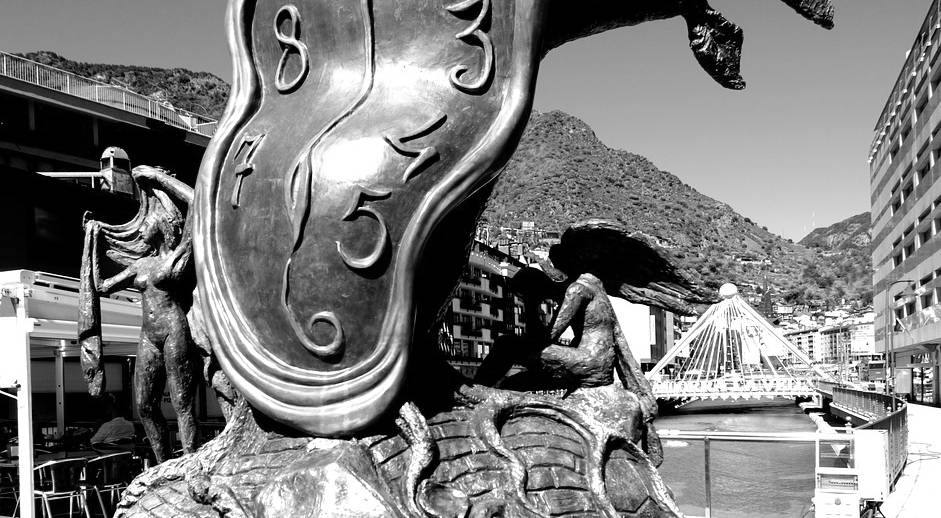
In the exact center of Andorra la Vella, where the Gran Valira river slides under the Pont de París and the avenues of Europe’s highest capital converge on a small paved square, a clock is dying with great dignity. It drapes itself over the trunk of a dead tree the way a damp coat drapes over a chair. A crown rests on its face, tilted, almost amused. An angel sits nearby in what might be grief and might be thought. A woman rises from a stone basin and looks toward the morning. Nothing in the scene is rigid. Nothing in the scene is in a hurry. And yet everything in the scene is, unmistakably, about time.
This is La Noblesse du Temps — The Nobility of Time — a monumental bronze sculpture by Salvador Dalí, and one of the most quietly profound public artworks in Europe. It is also one of the most photographed objects in Andorra, which creates a strange and very modern irony: thousands of people stop here every day to capture a single frozen instant of a sculpture whose entire argument is that instants do not exist the way we think they do.
This article exists to do something the hundreds of travel blogs about this statue do not attempt. It will not simply tell you where the sculpture is, how tall it is, and where to get the best selfie angle, although it will tell you those things, accurately and early, because accuracy is a form of respect. Its real purpose is to take the sculpture seriously as a philosophical object — to treat it the way Dalí treated his own work, as an idea given a body, not a decoration given a meaning.
Quick Facts: The Nobility of Time at a Glance
| Title | La Noblesse du Temps (French) / The Nobility of Time (English) |
| Artist | Salvador Dalí (1904–1989) |
| Conceived | 1977 |
| First bronze cast | 1984 |
| Material | Bronze, lost-wax casting, green-brown patina |
| Edition | Part of a numbered edition (350 + 35 artist’s proofs) for collector-scale casts; the Andorran installation is a monumental public cast |
| Height (public installation) | Approximately 5 meters (16 feet) |
| Current location | Plaça de la Rotonda, Andorra la Vella, Andorra |
| Installed at current site | 2010 |
| Previous location | Parc del Prat Gran, Encamp, Andorra (from 1999) |
| Donor | Enric Sabater, Dalí’s personal agent and collaborator (1968–1982) |
| Recipient | The Government of Andorra |
| Style / movement | Surrealism |
| Related painting | The Persistence of Memory (1931), Museum of Modern Art, New York |
The sculpture displaying a melting clock was crafted by the famous Catalan artist Salvador Dalí, and the melting clock, most famous in Dalí’s painting The Persistence of Memory, represents the passage of time. It was conceived in 1977 and first cast in 1984, in bronze with a green patina. The sculpture was cast in 1984 and visited many cities before being permanently installed in the city’s square in 2010, and it stands some five meters tall. It was gifted to the government of Andorra by Enric Sabater, who was Dalí’s agent between 1968 and 1982.
Where exactly is it, and How did it get there?
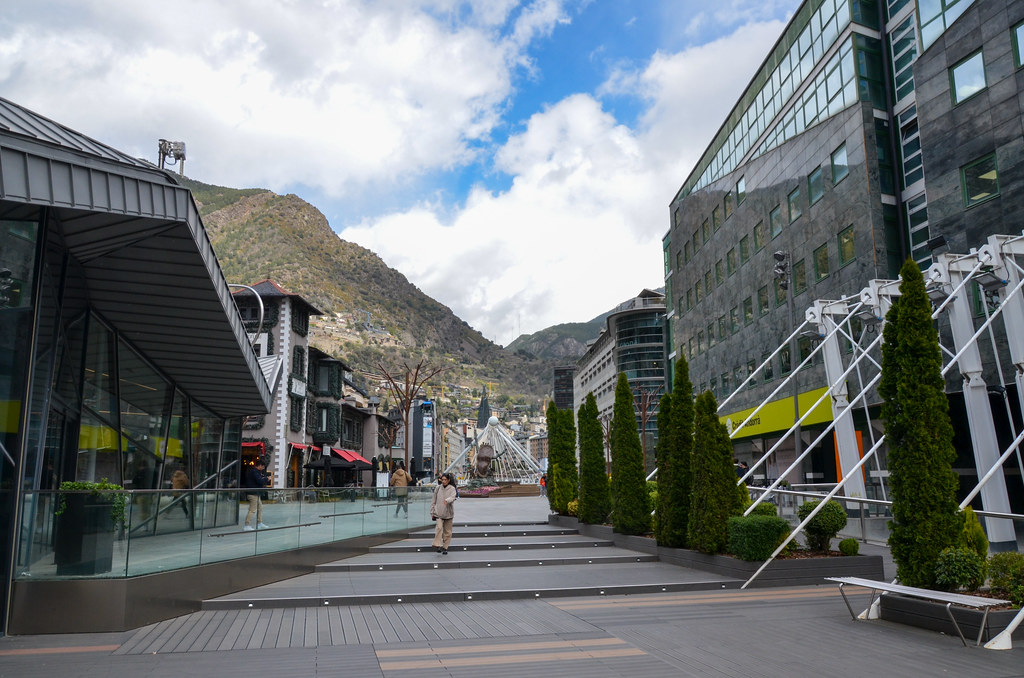
The sculpture stands in the Plaça de la Rotonda, a pedestrian square in the heart of Andorra la Vella, near the Pont de París bridge and the fast-flowing Gran Valira river. From the Andorra la Vella bus station, the plaza is reached by walking east along Avinguda de Tarragona and continuing onto Avinguda Meritxell, the city’s main shopping street — a walk of roughly ten to fifteen minutes. A tourist information office sits just steps away from the sculpture, and the surrounding area is full of restaurants and cafés.
The piece did not arrive at this spot in a straight line — itself a small, fitting joke for a sculpture about the non-linearity of time. The sculpture was originally gifted by Dalí to his friend and collaborator Enric Sabater, and it was initially installed in the Parc del Prat Gran in the Parish of Encamp in 1999. It was only in 2010 that it was relocated to its current, far more prominent position in the Plaça de la Rotonda, where it has since become one of the most notable landmarks of Andorra la Vella.
The choice of Andorra is not incidental. Dalí was born in Catalonia, the region of Spain to which Andorra is historically and culturally tied, giving the artist a deep connection to the country and the wider Pyrenean region. A sculpture about a clock that has stopped obeying clock-logic feels entirely at home in a micro-nation that has spent eight centuries refusing to fully obey the logic of its much larger neighbors, France and Spain.
Today, the plaza around the sculpture has become a kind of stage. Plaça de la Rotonda hosts nightly water-and-light shows, with synchronized fountains, lights, and music running in two sessions each evening, and visitors consistently single out Dalí’s sculpture as the centerpiece of the square’s identity, alongside its lively evening atmosphere of fountains and lighting.
Anatomy of the sculpture: reading every element
Most descriptions of The Nobility of Time stop at “melting clock.” This does the work a disservice, because the sculpture is not one symbol — it is an assembled argument, built from five distinct visual elements that only make sense in relation to one another.
1. The Soft Watch
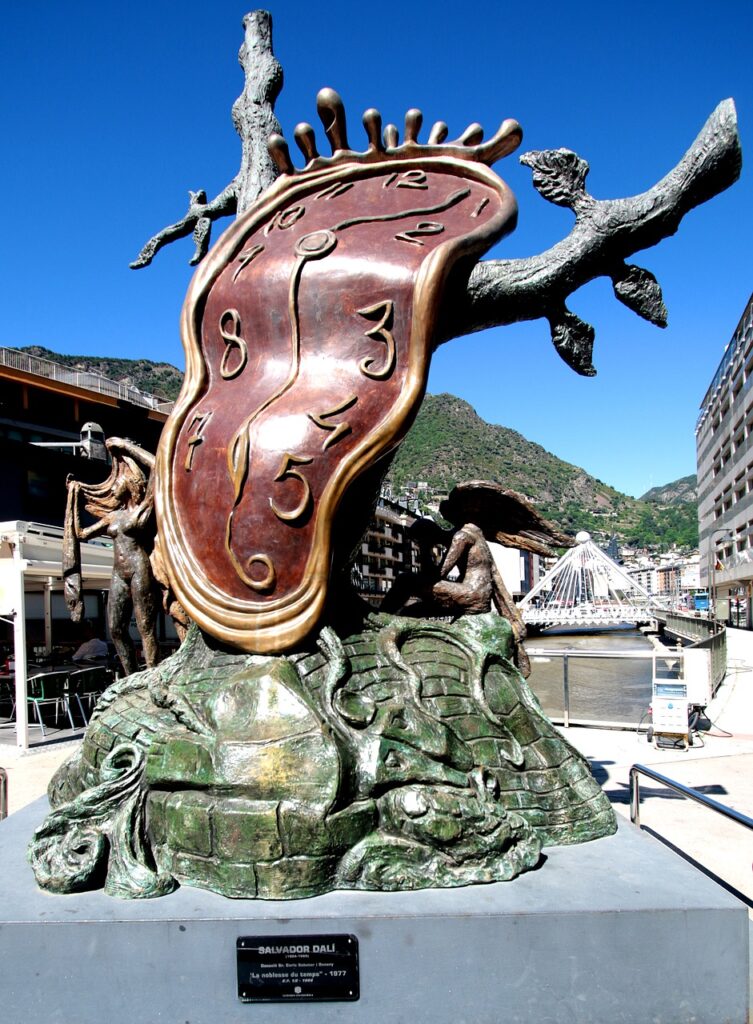
The central object is Dalí’s signature reloj blando — the soft watch — rendered here not lying flat across a ledge, as in The Persistence of Memory, but draped vertically over the branch of a tree, as though it had been hung out to dry, or had simply lost the will to hold its shape. The watch is stretched, and its malleable form seems to take the shape of the tree it hangs from. A clock face still has hands and numerals — it has not abandoned the idea of time-telling — but it has surrendered the rigidity that makes time-telling useful. It tells you what time felt like, not what time it is.
2. The Crown
Resting on the face of the watch is a crown — and this detail is where the sculpture’s title is hiding in plain sight. The crown of a watch normally refers to the small mechanical knob used to set the hands and wind the timepiece, the part that lets a human being adjust time to their own purposes. But in Dalí’s version, time has no internal power or motion and cannot be set — so the artist reinterprets the crown as a royal crown instead, one that identifies time’s mastery over human beings rather than time’s utility to them. Without that small mechanical crown, a watch cannot wind and cannot keep time, and Dalí deliberately plays on this: in his hands, time becomes irrelevant to the act of measuring, and impossible to set.
This is the conceptual hinge of the entire work. A normal crown — the kind on a normal watch — is a tool that lets you govern time. Dalí’s crown is a monarch’s crown. It does not let you set time; it announces that time has set itself above you. The “nobility” in the title is not a compliment. It is a demotion of the viewer.
3. The Tree
The watch is both draped against and supported by the remains of a tree, whose trunk sprouts new shoots and whose roots entwine a stone. The clock is mounted on this tree, whose roots penetrate a platform of brick — a recurring theme of decay and renewal that runs through nearly all of Dalí’s work. The tree is simultaneously dead enough to be a “remains” and alive enough to be “sprouting.” It is decay and growth occupying the same trunk at the same moment — which is, not coincidentally, exactly what a melting clock is doing to the concept of a single moment.
4. The Angel
An angel sits to one side of the sculpture, lost deep in thought, or perhaps in mourning. Dalí rarely explained his figures with the precision modern viewers crave, and this ambiguity is the point: contemplation and grief look almost identical from the outside, and the difference between them is mostly a matter of how much time has passed since the loss occurred.
5. The Woman
On the other side of the composition, a woman stands up from a bath, looking brightly ahead toward the new day. This juxtaposition of uncertainty and courage — the angel’s introspection against the woman’s forward-looking brightness — gives the sculpture a more palpable, human meaning. Where the angel looks backward or inward, the woman looks forward. Between them, draped over its dying tree, the watch looks nowhere at all — because it no longer has anywhere in particular to be.
From canvas to bronze: How The Persistence of Memory became The Nobility of Time
To understand this sculpture, you have to understand its parent painting. The original soft-watch image was created by Dalí in 1931, in a painting that became one of Surrealism’s most recognizable works, and which today hangs in the Museum of Modern Art in New York. That painting — The Persistence of Memory — gave the twentieth century one of its defining visual metaphors: limp pocket watches draped over a barren landscape, ants crawling across one of them, a fly perched on another.
Nearly half a century later, Dalí returned to that same image and asked a different question of it. The painting is called Persistence — it is about memory’s stubborn refusal to behave, its tendency to soften and pool and outlast the moment it was meant to record. The sculpture is called Nobility — it is about time itself, not memory, and about hierarchy rather than duration. The painting asks: why does the past refuse to stay fixed? The sculpture asks: who, exactly, is in charge here — you, or time?
This is not a minor shift in emphasis. It is the difference between a psychological claim and a political one. The Persistence of Memory is about the inside of a single mind. The Nobility of Time is about the relationship between any mind and the force that contains it. By the time Dalí cast this bronze, late in his career, after a lifetime spent being told by critics, collectors, and his own aging body that time eventually wins every argument, he was no longer painting a psychological symptom. He was issuing a verdict.
The Philosophy of a melting clock: Why “Nobility” is the right word
Here is where most articles about this sculpture stop, and where this one wants to begin.
Clock time vs. lived time
Philosophers have long distinguished between two kinds of time. There is clock time — the uniform, mechanical, interchangeable seconds that tick by identically whether you are asleep, in love, in pain, or in a waiting room. And there is lived time, sometimes called duration, which is how time actually feels from the inside: elastic, uneven, capable of stretching a single afternoon of grief into something that seems to last a year, and capable of collapsing a decade of happiness into something that feels, in retrospect, like a single afternoon.
A rigid clock face can only ever depict the first kind of time. It is, definitionally, a device for ignoring how time feels in favor of how time can be measured, divided, sold, and scheduled. Dalí’s melting clock is a clock that has stopped lying about this. It has stopped pretending that an hour at a funeral and an hour at a celebration are the same quantity of anything. The bronze sags exactly because lived time sags — because duration, unlike clock time, has weight, and weight bends things.
Why a Crown, and not a cage
It would have been easy — almost lazy — for Dalí to sculpt time as a tyrant, a cage, a guillotine. Many artists before and after him have done exactly that. Instead he gave it a crown. A crown is not merely a symbol of power; it is a symbol of legitimate, inherited, unelected power — authority that does not need to justify itself, because it was never granted by the people it rules. You do not vote for time. You do not get to file a complaint with time. Time was never appointed; it simply always was, the way a hereditary monarch simply always was, by the accident of birth rather than the merit of argument.
This is the precise, careful meaning of “nobility” in the title. Nobility, historically, is not raw force — a thug with a weapon is not noble. Nobility is force with a pedigree, force that has had so long to entrench itself that it has stopped looking like force at all and started looking like simply the way things are. Time has exactly this kind of authority over human beings. We do not experience time as an enemy to be fought; we experience it as a condition of existing at all, the water we swim in rather than the wall we hit. Dalí’s crown captures that distinction with unnerving precision: it is not a weapon resting on the watch face. It is a title.
The Tree as a counter-argument
And yet — and this is the part the title alone does not convey — the sculpture refuses to let time’s nobility go entirely unchallenged. The tree on which the watch hangs is simultaneously decaying and renewing: dead wood and new shoots in the same trunk, ancient roots and fresh brick in the same base. If time were truly an absolute monarch, nothing within its kingdom could ever be new. But something here is. The tree keeps producing shoots even as it serves, quite literally, as a coat-rack for time’s own crumbling instrument.
This is the sculpture’s quiet, second argument, easy to miss beneath the more obvious crown-and-clock symbolism: nobility is not the same as omnipotence. A king can rule a forest without being able to stop a single seed from sprouting. Time can govern every human life without being able to stop a single new thing from beginning inside that governed life. The angel mourns. The woman rises toward morning anyway. Decay and renewal share one root system. Dalí does not give us a sculpture about despair at time’s power; he gives us a sculpture about the strange, persistent dignity of going on regardless of that power — which may be the only kind of nobility available to anyone who is not, in fact, time itself.
Why this resonates more in a public Square than in a Gallery
There is something almost too perfect about where this sculpture ended up. A gallery visitor arrives already prepared to think about art, on their own schedule, having budgeted time specifically for contemplation. A pedestrian in Plaça de la Rotonda has budgeted no such thing. They are walking to a shop, to dinner, to a bus, glancing at a phone, half-thinking about a dozen other obligations — living, in other words, entirely inside clock time, inside the tyranny of the schedule — when a five-meter bronze monument to the limits of that tyranny interrupts their path. The sculpture functions less as a simple display and more as an educational object, inspiring dialogue about art, philosophy, and the passage of time among people who did not necessarily come looking for any of those things. The interruption is the point. You cannot schedule an encounter with the idea that scheduling has limits.
Provenance and Authenticity: Is the Andorra sculpture an original Dalí?
This is one of the most searched and most genuinely confusing questions surrounding the work, largely because Dalí’s sculptural output operated under different rules than his paintings.
“The Sculpture Collection,” the body of work to which Nobility of Time belongs, consists of the most iconic images from Dalí’s paintings translated into sculptural form — a body of work that was a direct product of the artist’s own involvement, focused on ideas over matter. The collector-scale bronze of Nobility of Time was produced in an edition of 350 numbered casts, plus 35 additional artist’s proofs (EA), each roughly 60 centimeters (about 23.6 inches) high, individually signed and inscribed “Dalí.” These bronzes were produced using the lost-wax process, and each comes with a certificate of authenticity and a foundry certificate, with the casting itself carried out by the Perseo foundry.
The five-meter public monument in Andorra la Vella is not one of these 350 numbered collector pieces — it is a separate, monumental-scale public cast of the same design, gifted directly by Sabater to the Andorran government. Even so, it is recognized as an original Salvador Dalí sculpture standing in one of the smallest countries in the world, and it forms part of a wider international presence of large-format Dalí bronzes. The Andorra sculpture belongs to a global collection of Dalí’s monumental works, many of which are overseen by the Dalí Universe organization — large-scale bronze editions of his most famous motifs that carry the Surrealist master’s vision into public spaces around the world, allowing wider audiences to interact directly with his imaginative world rather than viewing it only through glass in a museum.
For readers, collectors, and researchers, it is worth being precise about the distinction:
- The collector edition — roughly 60 cm tall, part of a signed and numbered run of 350 + 35 EA, intended for private and gallery collections.
- The monumental public cast — roughly 5 meters tall, a single large-scale realization of the same design, installed as public art and donated to a national government rather than sold to a private buyer.
Both are legitimate expressions of the same conceived work; they simply serve different purposes and live in different worlds — one behind glass, one beside a river in the middle of a capital city.
Why “Nobility of Time” Outperforms every other Dalí landmark in cultural resonance
It would be easy to assume that a five-meter bronze in a country of roughly 90,000 people would be a footnote compared to Dalí’s headline institutions — the Dalí Theatre-Museum in Figueres, the Dalí Museum in St. Petersburg, Florida, or The Persistence of Memory itself at MoMA. In practice, something different has happened. Visitors consistently single this piece out as one of the most distinctive features of the entire city, describing the surrounding plaza’s nightly water-and-light shows and the sculpture together as among the most memorable parts of an Andorran visit.
Part of this is circumstance: Andorra receives an enormous volume of cross-border day-trip tourism — visitors stopping for tax-free shopping who end up, almost accidentally, standing in front of a major work of twentieth-century Surrealism they did not plan to see. Andorra is not a large country, and seeing most of its landmark sights does not take long, which means the sculpture often functions as a single, concentrated dose of “high culture” inside an itinerary otherwise built around skiing, spas, and duty-free shopping.
But part of it is the work itself. A painting in a museum asks you to come to it, on its terms, inside a building built for exactly that purpose. A five-meter bronze in a town square asks nothing. It simply waits at the center of ordinary life — beside a bridge, near a bus stop, across from a phone shop — until ordinary life walks past it and, for a moment, has to look up.
Visiting The Nobility of Time: Practical Information
- Location: Plaça de la Rotonda, AD500 Andorra la Vella, Andorra — in the historic heart of the city, near the Pont de París bridge over the Gran Valira river.
- Access: Easily reachable on foot from most points in Andorra la Vella, including the main commercial avenues and most hotels.
- Cost: Free and outdoors, viewable at any time, day or night.
- Best time to visit: Early morning or late afternoon offers the best natural light for photographs. In the evening, the plaza adds a nightly water-and-light show, with synchronized fountains, lights, and music typically running in two sessions.
- Nearby: A tourist information center sits just a short walk from the statue, and the plaza is close to major shopping centers and surrounded by restaurants.
- Seasonal note: The square is especially noted around the Christmas season, when festive lighting and decorations transform the plaza after dark.
Frequently Asked Questions
Is the melting clock in Andorra the same as the one in The Persistence of Memory? No — they are related but distinct works. The original soft-watch image was created in the 1931 painting The Persistence of Memory, now housed at the Museum of Modern Art in New York. The Nobility of Time is a later, separate sculptural work that reuses and extends Dalí’s soft-watch motif in three-dimensional bronze, adding the crown, the angel, and the rising woman that do not appear in the original painting.
Why is it called “Nobility” of Time rather than something about melting or memory? Because the sculpture’s central image is a crown resting on the watch face, reinterpreting the watch’s mechanical “crown” (the part used to set and wind a normal timepiece) as a royal crown instead — a symbol of time’s mastery over human beings rather than its utility to them.
How did the sculpture end up in Andorra specifically? It was gifted to the Andorran government by Enric Sabater, Dalí’s personal agent between 1968 and 1982. It was first installed in Parc del Prat Gran in Encamp in 1999, then relocated to its current site in Plaça de la Rotonda in 2010.
Is it the only Dalí sculpture in Andorra? It is the most prominent and most visited, and the one most closely identified with the country’s capital, standing in the central square of Andorra la Vella.
How tall is the sculpture? The public bronze in Andorra stands approximately five meters (about sixteen feet) tall. Separately, a smaller collector’s edition of the same design exists at roughly 60 centimeters (about 23.6 inches), part of a signed, numbered edition of 350 casts plus 35 artist’s proofs.
Closing: The Statue That Refuses to Tell the Time
Every tourist who photographs The Nobility of Time is, in some small way, doing the opposite of what the sculpture is trying to teach them. A photograph is an act of arrest — it seizes one instant and insists that the instant was the important one, more important than the instants before and after it. Dalí’s bronze argues the reverse: that no single instant deserves that kind of authority, that the soft watch’s whole point is its refusal to let any one moment harden into “the time.”
And yet the contradiction is not really a failure on the visitor’s part. It may be the most honest tribute the sculpture could ask for. We photograph the melting clock precisely because we cannot live the way it depicts — we cannot actually exist outside clock time, outside schedules, outside the tyranny of the crown resting on the watch face. We are governed by that nobility every single day, whether we acknowledge the rule or not. What the bronze offers, standing quietly beside a river in the smallest of capitals, is not an escape from that rule but a brief, public, communal moment of seeing it — of watching power made visible in soft metal, crowned and dying and somehow still, against all logic, sprouting new shoots from an old root.
That, perhaps, is the real nobility on display in Plaça de la Rotonda. Not time’s nobility alone. Ours too — the strange, durable dignity of creatures who know exactly how the argument with time will end, and who keep walking toward the new day anyway, the way the woman in the bronze does, rising, looking forward, paying the crowned clock no mind at all.
Sources consulted include Atlas Obscura’s documentation of the sculpture’s history and symbolism, the Andrew Weiss Gallery and Galerie Montmartre’s catalog records of the collector edition, Dalí Paris’s interpretive notes on the watch-crown symbolism, Heritage Auctions’ lot records, and on-the-ground travel documentation of Plaça de la Rotonda in Andorra la Vella.