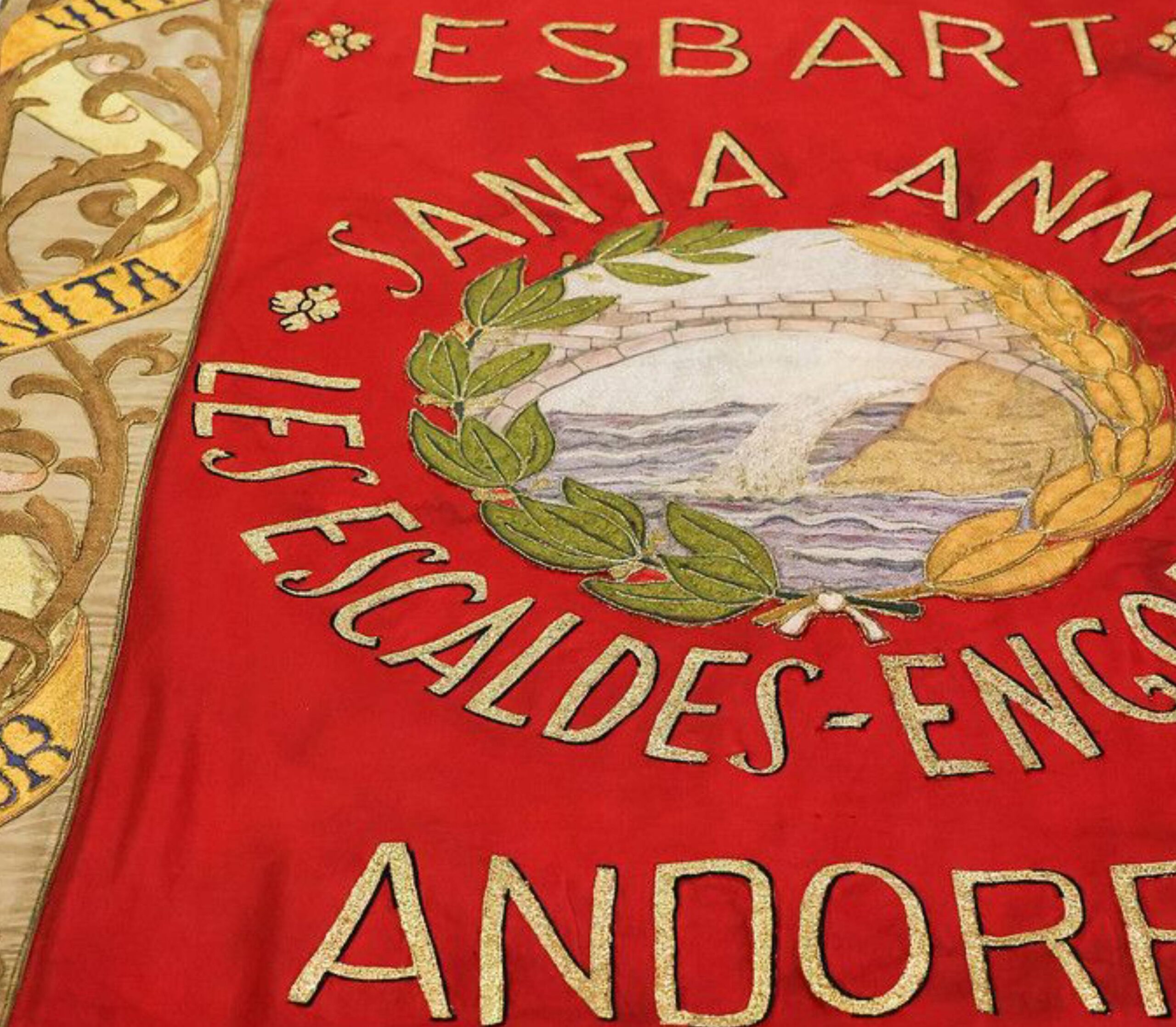
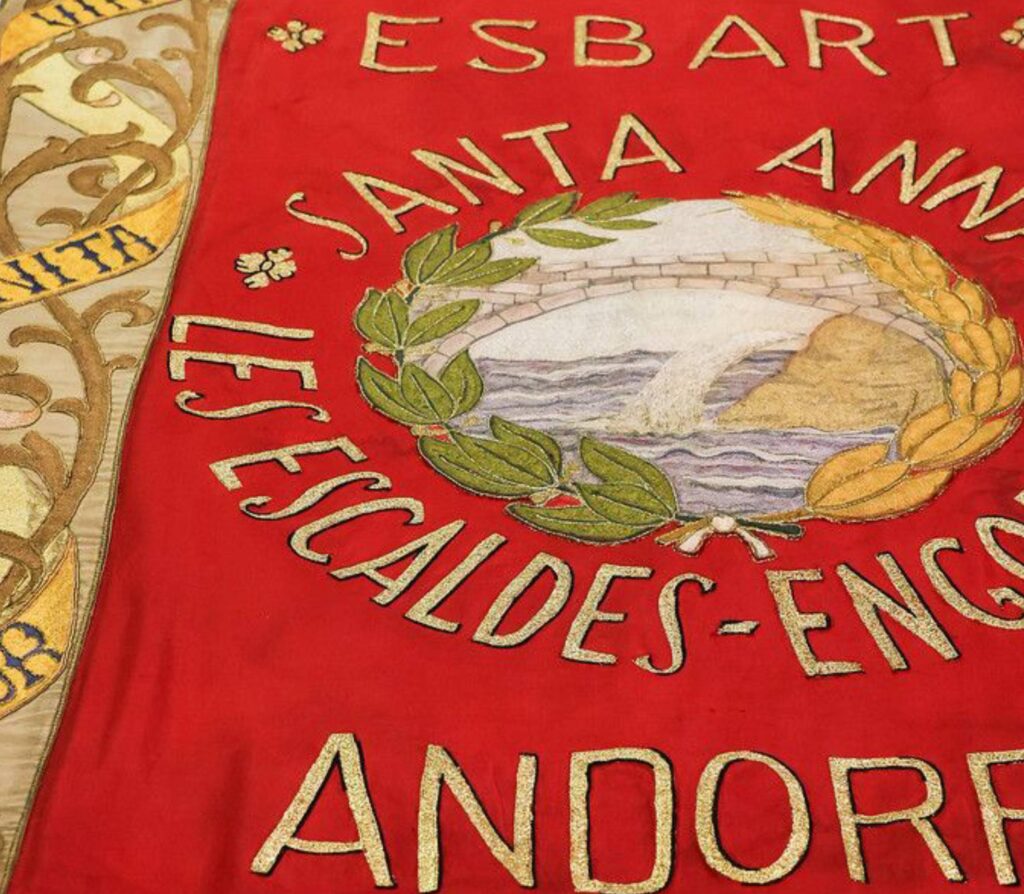
For 70 years it has been a part of the parish’s festivals, dances, and historical moments. After six months of restoration, one of Escaldes-Engordany’s great cultural symbols is back home. We are talking about the Official banner of the “Esbart Santa Anna”, in catalan, “L’estendard de l’Esbart Santa Anna”.
Some objects have value, while others hold memories. The historic banner of the Esbart Santa Anna belongs to the latter category. The Councilor of Culture, Valentí Closa, has highlighted the satisfaction with the recovery of the piece and has qualified the intervention as “excel·lent”.
But before understanding the importance of this banner you should know what the Esbart Santa Anna is and why is it important for Andorran people.
What is the Esbart Santa Anna?
Founded in 1950, the Esbart was not only a pioneer in preserving traditional Andorran dances, but it also became a school of collective identity. Antoni Albós Gabarra de Cal Tonet del Palau, known as Tonet, was the founder and first president of the Esbart Santa Anna.
Esbart Santa Anna is one of the oldest cultural entities in the country, dedicated to preserving, performing, and passing down the rich heritage of traditional Andorran and Pyrenean dances.The esbart acts as both a dance academy and a performing group, boasting around 120 members, from young children to adults.
Its name comes from the “Ball de Santa Anna” which was a popular dance in Escaldes-Engordany since the XVII Century. It is celebrated every July 26 in Plaça Santa Anna in Escaldes-Engordany as the central event of the Festa Major, right after the mass in honor of the patron saint.
The Dance “Ball de Santa Anna” has a strong similarity to the ancient Contrapàs Dance, also celebrated since centuries ago and stands out for its harmonic and ceremonial movements. When it comes to the clothing, the dancers recreate the Andorran past. Women dress like grandmothers on Sunday and men like the heirs of important Manors or Cases Pairals.
For almost seven decades, that piece has been present at popular celebrations, cultural events, and performances by Esbart Santa Anna, one of the most emblematic cultural institutions in the entire Principality. Esbart Santa Anna is the leading group for traditional dance in Andorra.
The Banner of the Esbart Santa Anna
The restoration has been structured in two differentiated phases. On one side, it has intervened on the textile part, both netting and consolidation of the fabric to preserve the original characteristics to the maximum. Furthermore, the structure and the decorative metal elements have been restored, with the objective of recovering the original appearance and guaranteeing the structural stability.
Some bands of the standard have also been restored, including those of the “Sindicat d’Iniciativa” (old Andorran Ministry of Tourism). This week it returned to Escaldes-Engordany after a six-month restoration process.
To many, it might simply appear to be an old piece of textile recovered from the ravages of time. However, for many families in the parish, it represents something much deeper: a part of their own history. The banner was created in 1956, but its history comes back from the XVII Century when the Ball de Santa Anna took place. In 1956, when it was born, Escaldes-Engordany was still very different from the parish we know today. In fact, Escaldes wasn’t even considered a parish, as it was a Quart and part of the Parish of Andorra la Vella.
Those who saw the parade for the first time grew up in an Andorra where tourism was just beginning to develop, where many of today’s streets didn’t exist, and where community life revolved around traditions passed down directly from parents to children.
Hundreds of people have passed through its ranks. Grandparents who danced in their youth. Parents who inherited the tradition. And now it is time for their grandchildren, who today continue to keep alive a legacy that began long before they were born.
That is why the restoration of the banner has an importance that goes far beyond heritage preservation.
A society that preserves its memory
We live in an age where everything seems designed to be replaced. Phones last only a few years (planned obsolescence), social media is constantly changing. and news disappears in a matter of hours.
In this context, it is extraordinary that a cultural symbol continues to be relevant after 76 years. The restoration of the banner is also a declaration of principles. It demonstrates that a community values what connects it to its roots. Because the identity of a place is built by preserving what explains who we are.
The true value of heritage
When we talk about heritage, many people imagine churches, monuments, or historic buildings. But heritage can also be a seemingly simple object.
It may be a banner, a photograph, a traditional costume. A piece that, on its own, is capable of telling the story of entire generations.
The banner of the Esbart Santa Anna is precisely that. It is not just a restored piece of fabric, but a silent witness to the evolution of Escaldes-Engordany. It has seen the parish grow. It has been present at moments of celebration. The banner hserves as a testimoney of the creation of the Parish as well as its growth and success. And now it returns to its rightful place.
A return that looks to the future
Perhaps the most important lesson of this story is that preserving heritage doesn’t mean being stuck in the past. It means understanding that a strong society needs memory.
Future generations will inherit an Andorra very different from the one we know today. Technology will change, and so will our way of life. But symbols like this will continue to remind us of where we come from. And as we said before, it is not only about the Esbart which dates back a history of more than 75 years, it is about honoring a Dance which has been part of Andorran History since XVII Century.
And that’s precisely why its return deserves to be celebrated. Because it’s not just a banner that’s returning. A part of the collective memory of Escaldes-Engordany is returning.