Andorra welcomes the world of advanced mathematics
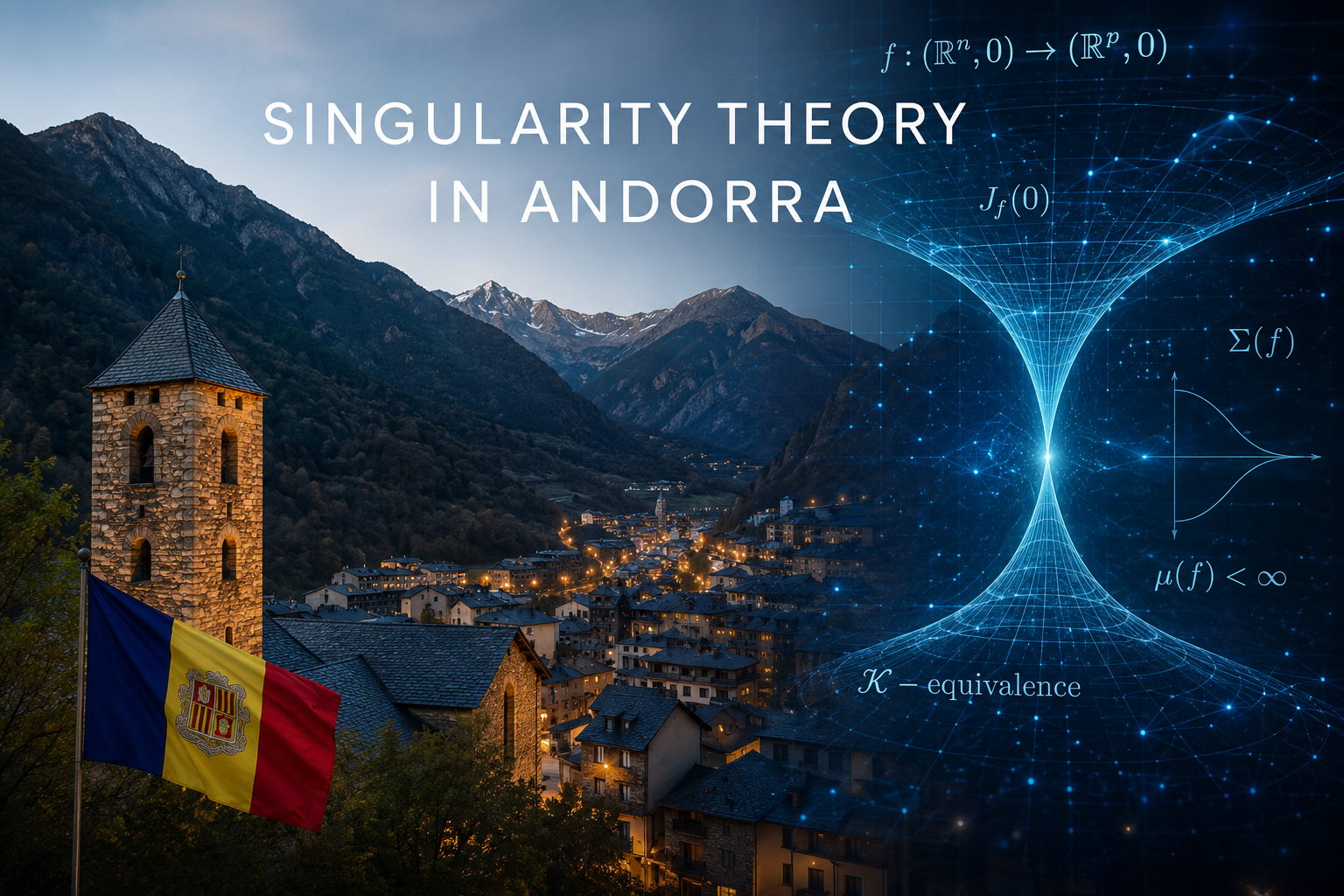
A small country in the Pyrenees has recently attracted attention from the international scientific community. Andorra hosted a major research gathering dedicated to one of the most complex areas of modern mathematics: singularity theory.
The international workshop brought together mathematicians and researchers from different countries to discuss new developments in a discipline that explores irregularities, complex structures, and the points where traditional mathematical models encounter challenges.
The event formed part of the IberoSing International Workshop 2026, a scientific meeting focused on singularity theory and related mathematical fields, with sessions held in Zaragoza and Andorra.
What is singularity theory and why is it important?
At first glance, the word “singularity” may sound like something related only to science fiction or black holes. In mathematics, however, singularities refer to points where structures behave differently from normal situations.
Singularity theory studies these unusual points and helps researchers understand how shapes, spaces, and mathematical systems change.
The field sits at the intersection of:
- Algebra
- Geometry
- Topology
- Computer science
- Physics
Researchers use singularity theory to analyse complicated forms and find ways to describe systems that appear impossible to simplify.
A simple example can be found in everyday objects. The sharp point at the end of a sheet of paper, for example, represents a type of geometric feature where normal smoothness breaks down.
Why was Andorra chosen for this international mathematics event?
The decision to bring part of the workshop to Andorra highlights the country’s growing role as a destination for scientific collaboration.
The final sessions took place at the Universitat d’Andorra, connecting international researchers with the country’s academic environment.
For Andorra, hosting advanced scientific events represents an opportunity to diversify its international profile beyond tourism and mountain activities, positioning itself as a place for innovation, education, and knowledge exchange.
From algebraic geometry to future technologies
Although singularity theory is highly theoretical, its impact extends into areas connected with modern technology and science.
Researchers study singularities because they appear naturally in many complex systems, including:
- Mathematical models used in physics
- Computer-generated geometric structures
- Engineering simulations
- Data analysis
- The study of complex spaces
Understanding irregular structures can help scientists create better models and improve how machines and computers process complicated information.
International researchers gather in the Pyrenees
The Andorra meeting was part of a broader ten-day programme that began at the Universidad de Zaragoza before moving to Andorra.
The workshop included senior mathematicians and young researchers, offering opportunities for collaboration, academic development, and the exchange of new ideas.
For young scientists, international workshops such as this provide access to experts and help build future research networks.
Andorra’s emerging role in science and innovation
The arrival of an international mathematics congress reinforces a broader trend: smaller countries can play a significant role in global scientific networks.
By attracting specialised conferences, universities, and researchers, Andorra is building visibility in areas such as:
- Higher education
- Scientific cooperation
- Digital innovation
- Research and development
The singularity theory congress shows that scientific influence is not only determined by size. Knowledge networks can also grow in unexpected places.
Conclusion: A small country hosting big mathematical questions
The presence of international experts studying singularity theory in Andorra demonstrates the country’s increasing connection with global research communities.
Behind abstract mathematical concepts are questions that influence how humanity understands shapes, systems, technology, and the structure of the world around us.
For a country known internationally for its mountains, this event highlights another landscape: the world of ideas.
FAQ section
What is singularity theory in mathematics?
Singularity theory is a branch of mathematics that studies points where structures become irregular or where normal mathematical rules require new approaches.
Why was there a singularity theory conference in Andorra?
Andorra hosted part of the IberoSing International Workshop 2026, bringing researchers together at the Universitat d’Andorra to discuss developments in singularity theory.
Is singularity theory related to artificial intelligence?
Indirectly. Mathematical methods developed to understand complex structures can contribute to fields involving modelling, computation, and advanced algorithms.
What scientific events take place in Andorra?
Andorra hosts international events in areas including education, science, technology, sport, and research, with universities and institutions increasingly involved in international collaboration.
Academic References and Sources
Primary Sources: Event Documentation
IberoSing International Workshop 2026. (2026).
IberoSing International Workshop 2026: Singularity Theory & Related Topics.
Organized by the Iberoamerican Webinar of Young Researchers in Singularity Theory and related topics. The official workshop page provides information on the scientific objectives, locations, programme, invited speakers, and organization of the event held in Zaragoza and Andorra.
Available at:
IberoSing International Workshop 2026 official website
IberoSing — Iberoamerican Webinar of Young Researchers in Singularity Theory and Related Topics. (2026).
Research network and scientific seminar platform.
This official academic network provides background information about the IberoSing initiative, its research community, previous workshops, and activities related to singularity theory.
Available at:
IberoSing Research Network official website
Universitat d’Andorra. (2026).
Participation and hosting of the IberoSing International Workshop 2026.
Institutional information related to the university’s involvement in hosting international academic activities in Sant Julià de Lòria, Andorra.
Available through:
Red de Geometría Algebraica y Singularidades – IberoSing information
Institutional and Academic Network Sources
Red de Geometría Algebraica y Singularidades (RGAS). (2026).
IberoSing: Iberoamerican Webinar of Young Researchers in Singularity Theory and Related Topics.
Academic network supporting research collaboration in algebraic geometry, singularity theory, and related mathematical areas.
Available at:
RGAS IberoSing page
Martín-Morales, J. (2026).
Conference Organizer: IberoSing International Workshop 2026.
University of Zaragoza researcher profile documenting participation in the organization of international mathematical conferences, including IberoSing 2026.
Available at:
Jorge Martín-Morales conference organizer page
Scientific Context References: Singularity Theory
SINGACOM — Singularities, Algebra, Geometry and Computation Network. (2026).
International Conferences in Algebra, Geometry and Singularity Theory.
Conference database placing IberoSing 2026 within the international scientific ecosystem of singularity theory and related mathematical research.
Available at:
SINGACOM Conference Database
Senovilla, J. M. M. (2018).
Singularity Theorems and Their Consequences.
arXiv:1801.04912.
A scientific review discussing mathematical and physical concepts related to singularities, particularly in the context of spacetime geometry and theoretical physics.
Available at:
arXiv — Singularity Theorems and Their Consequences